

Picking the best 360 feedback tools is harder than it should be, because they aren't priced the same way. Some charge per seat per month. Some charge per person receiving feedback, once a cycle. Some charge a flat fee that ignores headcount entirely.
Line those three models up in a table and the numbers look comparable. They aren't. A 30-person 360 cycle costs $1,080 a year on one model and $3,600 on another for functionally similar output.
This guide sorts twelve 360 feedback tools by pricing model first, then by what they're actually good at. Every figure was checked against the vendor's own site in September 2026, and where a vendor publishes nothing, we say so. If you are looking for our own 360 feedback software rather than a comparison of everyone else's, that page covers it.
TL;DR: The Best 360 Feedback Tools, Grouped by How They Charge
Per seat, per month — cost scales with headcount, cycles are unlimited.
- Effy AI — $3/seat/month, free up to 5 users, no minimums.
- Teamflect — free to 10 users, then $9/user/month. Built into Microsoft Teams.
- PerformYard — $5–10/person/month, undisclosed minimum.
- Lattice — Performance module $10/seat/month, $4,000 annual floor.
- 15Five — Perform $11/user/month, annual billing only.
- Culture Amp and Leapsome — not published, quote only.
Per appraisee — cost scales with how many people you review, not how many you employ.
- Spidergap — $1,099/year including 10 recipients, then $89 each.
- CustomInsight (Focal 360) — $750 setup, then about $95 per person reviewed.
Flat or survey-based — repurposed research tools.
- Pointerpro — $69/month, but only one user seat included.
- Qualtrics — not published; 360 is an add-on to an employee experience licence.
- Explorance Blue — not published, quote only.
How 360 Feedback Software Pricing Actually Works
This is the part that decides your bill, and almost no comparison article explains it.
Per seat, per month
You pay for everyone in the company, every month, and run as many cycles as you like. This is how performance platforms price, because 360 is one feature among goals, reviews and one-on-ones.
It's the cheapest model if you run 360s regularly across the whole company. It's poor value if you review twelve leaders once a year and nobody else.
Per appraisee
You pay per person receiving feedback. Raters and admins are free. Spidergap and CustomInsight both work this way — a 360 feedback assessment is the billable unit, not a seat.
This is the cheaper model when 360 is a targeted leadership exercise. Spidergap's licence activates when you create the assessment and lasts twelve months, so a company of 500 that reviews 20 executives pays for 20, not 500.
It becomes expensive fast if you want company-wide feedback. On Spidergap's Starter tier, 200 appraisees works out at $18,009 a year.
Flat or survey-based
Survey platforms like Pointerpro, SurveyMonkey and Jotform can technically run a 360. You build the form, distribute it, and assemble the reports.
The price looks attractive until you count the work. None of them handle rater nomination, anonymity thresholds, automated reminders per relationship type, or aggregated per-competency reporting without manual assembly. Pointerpro's $69/month includes exactly one user seat; multi-user is quote-gated. SurveyMonkey's Team Advantage has a three-seat minimum at $30 each.
Use these if you're running one 360 ever. For anything recurring, the admin time costs more than the licence you saved.
The Most Common Criticism of 360 Feedback
The most common criticism is that 360 feedback gets used for evaluation when it was designed for development — and the moment people know their peer ratings affect someone's pay or promotion, the ratings stop being honest.
The related complaints follow from that one:
- Reciprocity and score inflation. If I rate you generously and you rate me generously, we both look good. Anonymous peer selection makes this worse, not better.
- Vague, unusable comments. "Great team player" tells nobody what to do differently on Monday.
- Recency bias. Raters remember the last six weeks, not the year.
- Survey fatigue. Ask a manager to complete nine reviews of 30 questions each and quality collapses by the fourth.
- No follow-through. A report nobody acts on trains people to treat the next cycle as theatre.
Only some of this is a software problem, and it's worth being honest about which. Tools can enforce minimum rater counts, hide results below an anonymity threshold, prompt for specifics when an answer is thin, cap survey length, and route results into a development plan. Tools cannot stop you using development feedback in a promotion decision. That one's on the process.
When you're evaluating 360 degree feedback software, ask each vendor how it handles rater anonymity thresholds and comment quality specifically. Those two answers separate the serious tools from the form builders.
AI-Powered 360 Feedback Reviews: What the AI Actually Does
Almost every tool on this list now markets AI-powered 360 feedback reviews. The phrase covers four different jobs, and they are not equally useful.
- Writing the questions. Effy AI generates the form by role and review type. This is the lowest-risk use of AI in the cycle, because you read the questions before anyone answers them.
- Improving comments as they are written. Quality scoring and follow-up prompts push a rater to replace "great team player" with something specific, before they submit. Effy AI scores each open response and asks a follow-up based on the rating given. Leapsome offers reframing suggestions as you write.
- Summarising one person’s feedback afterwards. Effy AI, Leapsome, Lattice and Betterworks all produce a narrative summary per person. Culture Amp does the same on its Perform side.
- Analysing comment text in bulk. Sentiment, topics and trends across hundreds of responses at once. Culture Amp, Qualtrics and Workday all do this — but for engagement surveys, not 360. Culture Amp states in its own documentation that text analytics is not available for Individual or Leadership Effectiveness 360 surveys.
Two questions cut through the marketing. Does any of it have a published accuracy rate? No vendor in this comparison publishes an accuracy rate, an error rate or a hallucination rate for AI that reads employee feedback. Culture Amp is the only one to publish figures at all, and they are relative to its own earlier model rather than absolute. Who checks the output before the employee reads it? 15Five states that its AI cannot submit a review and that the writer chooses every rating. Leapsome requires human review for rating adjustments. Qualtrics describes its comment analysis as working without requiring manual review.
One tool here claims no AI at all: Spidergap. That is a positioning choice rather than a gap — it competes on how readable its reports are instead.
If you take one thing from this section: AI that nudges a rater while they are writing is worth more than AI that summarises afterwards. A model handed five vague comments returns a fluent, vague summary. For where AI sits in the rest of the stack, AI HR software covers the wider category.
Best 360 Feedback Tools: Dedicated Specialists
1. Effy AI — Best Overall
{{banner-3="/banner-page"}}
Effy AI runs 360 feedback as part of a full review cycle rather than as a standalone survey. AI generates the questions for the role, nudges raters when an answer is too thin to be useful, and writes the summary — which addresses two of the criticisms above directly.
Pricing is per seat with no minimum, no contract and no implementation fee, plus a pay-per-cycle option if you only run 360s once a year.
Key features:
- AI-generated 360 questions by role and review type
- Bias checks and quality nudges on written feedback
- Self, manager, peer and direct-report views in one cycle
- AI-written summaries per person and per review cycle
- Heatmap and 9-box insights
- Runs inside Slack
Pricing: Free for up to 5 users. From $3/seat/month billed annually ($6 for multiple cycles per user per year). See full pricing.
Best for: Teams of 10–300 that want company-wide 360s without an HR ops function.
Watch out for: Younger than the incumbents, so some edge-case reporting is still being built out.
2. Spidergap — Best Dedicated 360 Specialist
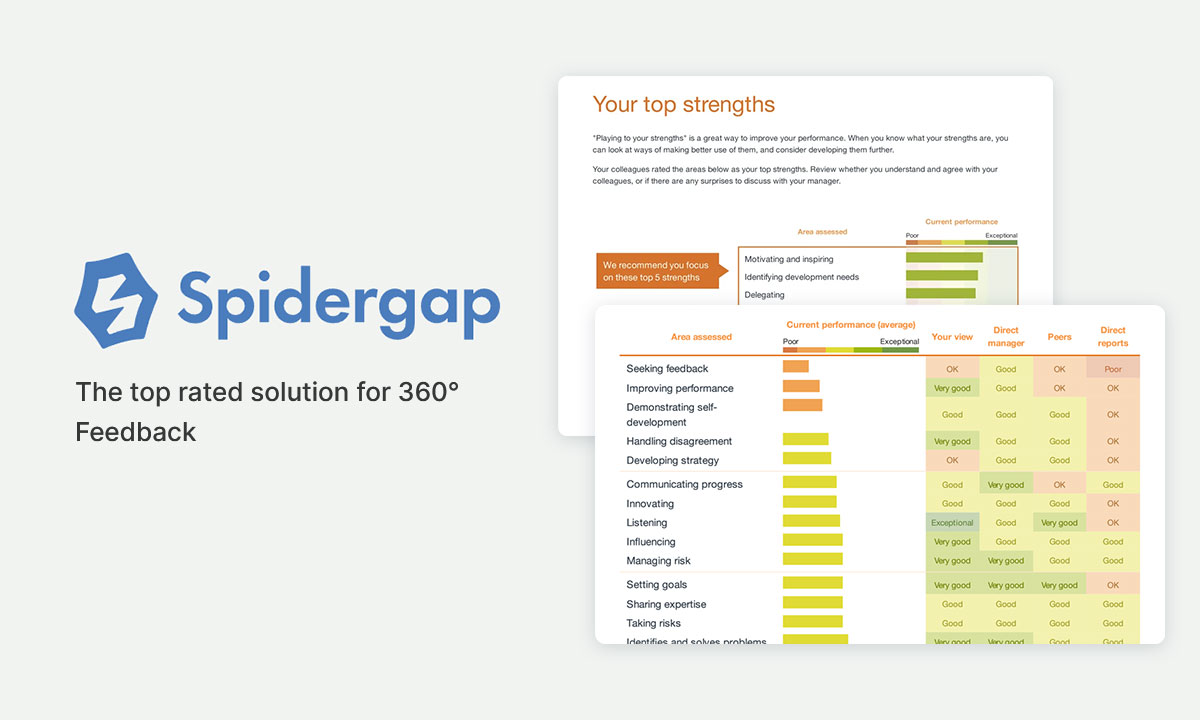
Spidergap does one thing and does it properly. The reports are the strongest in this list for a leadership audience — clear prioritisation of what to act on rather than a wall of averages.
Key features: Fully customisable competency frameworks, rater nomination workflows, action-planning output, benchmarking, expert setup support.
Pricing: Per feedback recipient, not per seat. Starter $1,099/year including 10 recipients, then $89 each. Pro $2,199/year including 10, then $59 each. Unused licences carry over; a licence lasts 12 months from the date you create the assessment. Raters and admins aren't charged. One free assessment to trial.
Best for: Targeted leadership 360s in companies of any size — you pay for the 20 people you review, not the 500 you employ.
Watch out for: Only 2 G2 reviews, which is thin for due diligence. Costs escalate quickly if you want company-wide coverage.
3. CustomInsight (Focal 360) — Best for Consultative Setup
CustomInsight sits between software and service. You get help designing the competency model, which matters if this is your first 360 and you don't have a framework.
Key features: Custom competency models, unlimited raters per participant, narrative reports, group and org-level rollups, consultative onboarding.
Pricing: Per participant receiving feedback. $750 one-time setup, then from about $95 per person reviewed, with unlimited raters and no per-report charge. One person free to trial.
Best for: First-time 360 programmes that need design help as much as software.
Watch out for: No aggregate G2 rating published. The $750 setup makes small pilots proportionally expensive.
4. Qualtrics — Best for Large Research-Led Organizations
Qualtrics 360 Development is part of its employee experience suite. The analytics are genuinely best-in-class if you have the scale and the team to use them.
Key features: 360 development, engagement and lifecycle surveys, advanced statistical analysis, text analytics on open comments, benchmarking.
Pricing: Not published. 360 Development is sold as coverage added to a People Lifecycle licence priced by employee count. Quote only, no free plan or trial.
Best for: Organizations above roughly 1,000 employees with a people-analytics function.
Watch out for: 360 is an add-on to a suite, so you're buying more than 360 whether you want it or not.
5. Explorance Blue — Best for Academic and Regulated Settings
Explorance is strong in higher education and heavily governed environments where audit trails and process control matter more than speed.
Key features: Highly configurable feedback workflows, integration with student and HR information systems, granular permissions and reporting.
Pricing: Not published. The pricing URL redirects to a product page with demo CTAs only. Quote only.
Best for: Universities and regulated organizations with formal review governance.
Watch out for: Nothing verifiable to compare on cost, and 55 G2 reviews is modest for an enterprise purchase.
360 Feedback Platforms With Reviews and Goals Built In
6. Culture Amp — Best for Engagement-Led Programmes
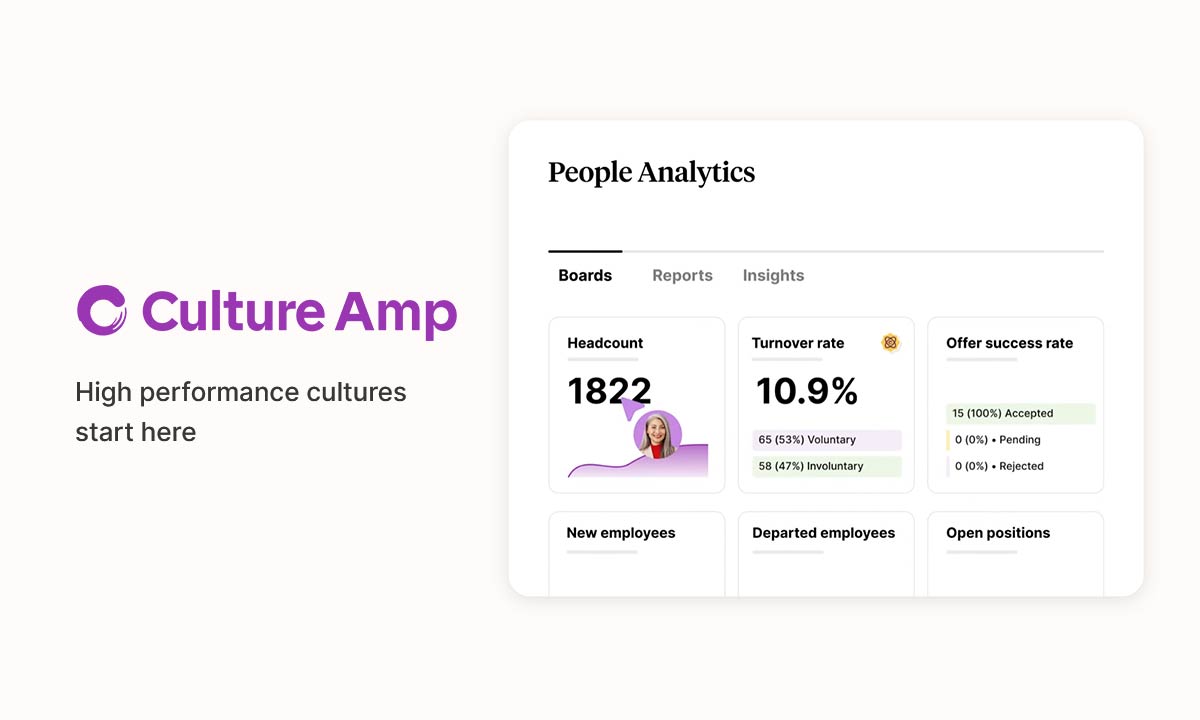
Culture Amp's 360 sits alongside its engagement surveys, so you can correlate feedback themes with engagement data. That connection is the reason to choose it.
Key features: 360 and self-review cycles, engagement and lifecycle surveys, competency frameworks, people analytics, benchmarking against its survey dataset.
Pricing: Not published. Quote only, billed annually. No free plan or trial.
Best for: HR-mature organizations above 200 people already running engagement surveys.
Watch out for: You can't shortlist it on price, and the performance half is newer than the survey half.
7. PerformYard — Best for Custom 360 Workflows
PerformYard lets you define exactly who reviews whom, on what scale, in what sequence. If you have an existing 360 process you don't want to change, this bends further than most.
Key features: Custom review cycles and rating scales, flexible rater selection, goal management linked to feedback, reporting dashboards.
Pricing: $5–10 per person per month billed annually. The site notes "minimum pricing applies" without stating the minimum; the real quote is form-gated.
Best for: Companies with an established 360 process and specific structural requirements.
Watch out for: No budget without a sales call, and less AI assistance on comment quality than newer tools.
8. Lattice — Best for Companies Scaling Past 200
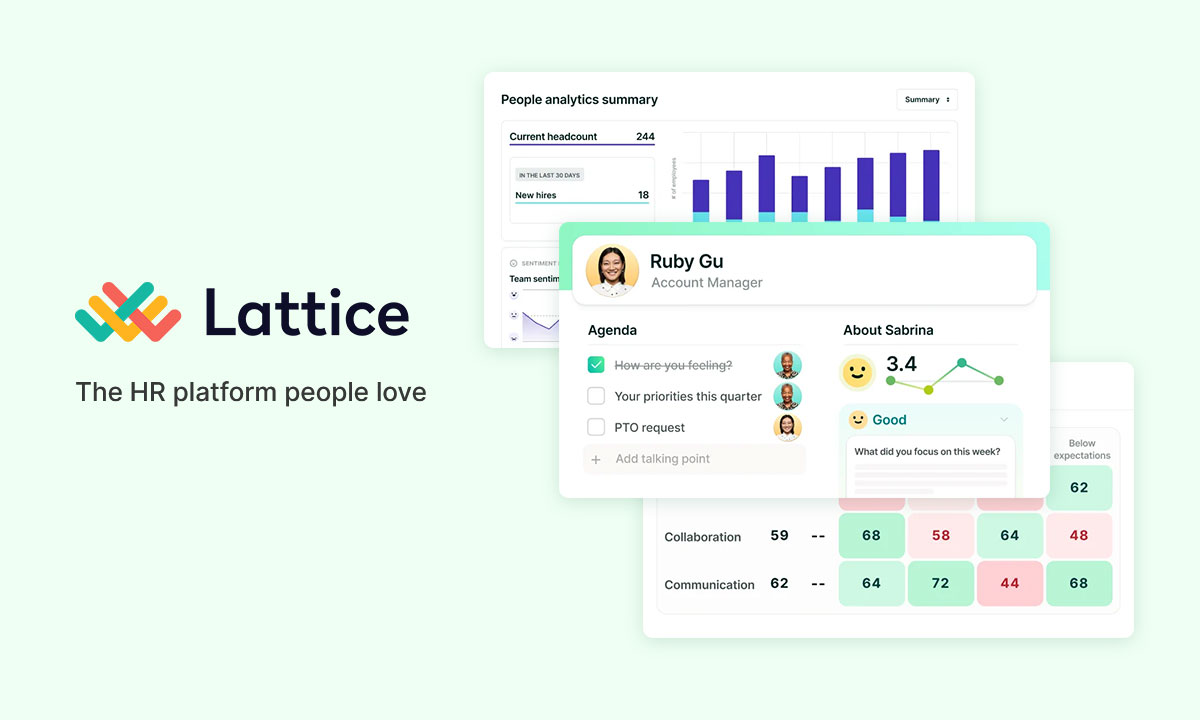
Lattice's 360 is solid and sits inside the deepest analytics stack in the category. The constraint is the floor price.
Key features: 360 and upward reviews, goals and OKRs, engagement surveys, one-on-ones, calibration, career frameworks.
Pricing: Performance module $10/seat/month à la carte, or Foundations $13/seat/month — both under a $4,000 minimum annual agreement. No free plan or trial.
Best for: Companies at 150–500 employees that want 360 as one part of a full platform.
Watch out for: The $4,000 floor makes a 30-person 360 programme cost $4,000 regardless of the per-seat maths.
9. 15Five — Best for Manager-Led Development
15Five wraps 360 in manager coaching and weekly check-ins, which is a reasonable answer to the follow-through criticism — feedback lands in an ongoing conversation rather than a PDF. If managers are the weak link in your cycle, 360 feedback for managers covers how to brief them.
Key features: 360 reviews, weekly check-ins, one-on-ones, OKRs, engagement surveys, manager training content.
Pricing: Perform $11/user/month, annual billing only. 14-day trial, form-gated.
Best for: Companies of 100–1,000 investing in manager capability alongside the feedback itself.
Watch out for: Annual billing only, and a lot of platform if 360 is all you need.
10. Leapsome — Best for 360 Tied to Development Paths
Leapsome connects 360 results to competency frameworks and learning modules, so a low score routes to something a person can actually do next.
Key features: 360 and peer reviews, competency frameworks, learning paths, goals and OKRs, one-on-ones.
Pricing: Not published — quote only. Confirmed one-year minimum contract term. No free plan or trial.
Best for: Companies with a real L&D function that want feedback and development in one system.
Watch out for: Blind negotiation on both price and contract length.
11. Teamflect — Best Inside Microsoft Teams
If your company runs on Microsoft Teams, Teamflect is the lowest-friction option here. Reviews happen in Teams rather than in a separate tool, which does more for completion rates than any feature.
Key features: 360 and performance reviews inside Teams, goals and OKRs, one-on-ones, recognition, task management.
Pricing: Free for up to 10 users with full functionality. Essential $9/user/month, Professional $14/user/month on annual billing (monthly billing is higher). 30-day free trial. Up to 60% nonprofit discount.
Best for: Microsoft-first companies, and small teams that fit the genuinely capable free tier.
Watch out for: Little value if your team lives in Slack rather than Teams.
Survey Tools Repurposed for 360
12. Pointerpro — Best of the Survey-Builder Route
Pointerpro is the strongest survey platform for this use case because it can generate personalised PDF reports automatically, which is the part that usually kills the DIY approach.
Key features: Custom assessment builder, automated personalised report generation, conditional logic, benchmarking.
Pricing: Professional $69/month for 2,000 monthly responses — but only one user seat is included, and additional admin seats are quote-only. Higher tiers are all "on request." 14-day trial.
Best for: Consultants running 360s for clients, or a one-off internal exercise.
Watch out for: The single-seat limit makes HR-team administration awkward. No rater nomination workflow, no anonymity thresholds — you build that yourself.
Also in this category: SurveyMonkey Team Advantage at $30/user/month with a three-seat minimum, and Jotform from $39/month with multi-user only on Enterprise. Both can build the form. Neither manages a 360 process. For continuous feedback rather than a periodic cycle, employee feedback software is a different category again.
What 360 Feedback Actually Costs
Here's the same programme — 30 people receiving feedback, once a year — priced across the models, using published rates:
- Pointerpro: $828/year (one seat only)
- Effy AI: $1,080/year
- SurveyMonkey Team Advantage: $1,080/year (3-seat minimum)
- PerformYard, low end: $1,800/year
- Spidergap Starter: $2,879/year ($1,099 + 20 extra recipients at $89)
- CustomInsight: $3,600 first year ($750 setup + 30 × $95), $2,850 after
- Teamflect Essential: $3,240/year
- Spidergap Pro: $3,379/year
- 15Five Perform: $3,960/year
- Lattice: $4,000/year — the annual floor, not the seat maths
Culture Amp, Leapsome, Qualtrics and Explorance can't be placed. None publish a rate.
Two things change this picture. If you review everyone rather than 30 people, per-seat tools stay flat while per-appraisee tools multiply — Spidergap Starter for 200 appraisees is $18,009 a year. If you review only a handful of executives, per-appraisee wins easily and a per-seat platform is dead weight.
Work out your appraisee count before you compare anything.
What Good 360 Feedback Looks Like
Useful 360 feedback is specific, behavioural and forward-looking. Compare:
Weak: "Great communicator, always helpful."
Strong: "In the Q2 planning sessions you summarised each team's position before proposing a direction, which got us to a decision in one meeting instead of three. In written updates the same clarity is missing — the last two project notes buried the decision in paragraph four. Lead with the decision."
The second version names the situation, the behaviour, the effect, and one concrete change. That's the standard to aim for, and it's what quality nudges in software are trying to produce.
For question wording and cycle structure, our 360 review template covers the mechanics, 360 feedback questions has the wording itself, and 360 feedback examples shows more written samples like the one above. If 360 is one part of a larger cycle, performance appraisal software compares the broader platforms.
360 Feedback Software, 360 Feedback Platform, 360 Review Software: Any Difference?
Very little, and vendors use all of those plus "360 assessment tools" for the same thing. Search for 360 review software or a 360 review platform and you land on the same twelve products.
The distinction worth drawing is scope, not vocabulary. A dedicated 360 feedback tool does one job and usually charges per person receiving feedback — Spidergap and CustomInsight are the examples here. A 360 feedback platform means 360 is one module inside a system that also runs goals, reviews and one-on-ones, and it usually charges per seat per month — Lattice, 15Five, Culture Amp, Leapsome and Effy AI work that way. The first is better value for a targeted leadership exercise, the second for company-wide feedback you want connected to the rest of the review cycle. Decide which you are buying before comparing prices, because the two models do not line up.
How to Choose
Count your appraisees, not your employees. This single number decides which pricing model wins, and it's the step most buyers skip.
Decide whether 360 is developmental or evaluative — and say so out loud. If ratings feed promotion decisions, expect inflation and buy a tool with strong anonymity thresholds. If it's purely developmental, say that to participants explicitly or they'll assume otherwise.
Ask two specific questions on every demo. How does the tool enforce minimum rater counts before showing results? And what does it do when someone writes "great job" in a comment box? The answers separate real 360 platforms from form builders.
Ask what the AI is allowed to decide. Every vendor here markets AI. Few will tell you whether a human has to approve an AI-written summary before the person it describes reads it, and none publishes an accuracy rate. Ask both on the demo.
Pilot on one team. A 360 programme that half the company ignores is worse than none — it teaches people the exercise is optional.
Effy AI is free for up to 5 users, no credit card. Run a cycle and see the output before you commit.
